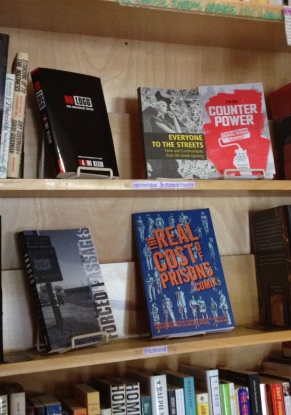
Reader at RCPP book event at Babylon Falling Bookstore in San Francisco
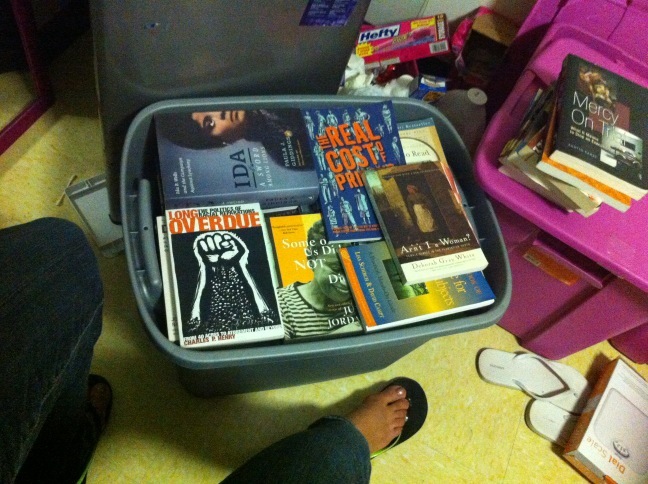
RCPP book in very good company! (Brit Williams packed books after graduating from college)
More good company. Bluestockings, NYC. May 2015. Photo: Diana Riddle
Iris, 8 year old activist in training
Books
23/7: Pelican Bay Prison and the Rise of Long-Term Solitary Confinement
By Keramet Reiter. Yale University Press. 2016. How America’s prisons turned a “brutal and inhumane” practice into standard procedure. Originally meant to be brief and exceptional, solitary confinement in U.S. prisons has become long-term and common. Prisoners spend twenty-three hours a day in featureless cells, with no visitors or human contact for years on end, and they are held entirely at administrators’ discretion. Keramet Reiter tells the history of one “supermax,” California’s Pelican Bay State Prison, whose extreme conditions recently sparked a statewide hunger strike by 30,000 prisoners. This book describes how Pelican Bay was created without legislative oversight, in fearful response to 1970s radicals; how easily prisoners slip into solitary; and the mental havoc and social costs of years and decades in isolation.
Abolition Geography: Essays Towards Liberation
By Ruth Wilson Gilmore. Verso. 2022
Gathering together Ruth Wilson Gilmore’s work from over three decades, Abolition Geography presents her singular contribution to the politics of abolition as theorist, researcher, and organizer, offering scholars and activists ways of seeing and doing to help navigate our turbulent present.
Abolition Geography moves us away from explanations of mass incarceration and racist violence focused on uninterrupted histories of prejudice or the dull compulsion of neoliberal economics. Instead, Gilmore offers a geographical grasp of how contemporary racial capitalism operates through an “anti-state state” that answers crises with the organized abandonment of people and environments deemed surplus to requirement. Gilmore escapes one-dimensional conceptions of what liberation demands, who demands liberation, or what indeed is to be abolished. Drawing on the lessons of grassroots organizing and internationalist imaginaries, Abolition Geography undoes the identification of abolition with mere decarceration, and reminds us that freedom is not a mere principle but a place.
All Alone in the World
By Nell Bernstein. Nationwide, more than seven million children are
affected by the criminal justice system and can claim a parent in prison or
jail, or under parole or probation supervision. All Alone in the World
describes the impact of the criminal justice system on these children,
highlights policy implications, and suggests a checklist for addressing these
issues. November 2003.
An American Radical: A Political Prisoner in My Own Country
By Susan Rosenberg. A story that is both a powerful memoir and a profound indictment of the U.S. prison system, Rosenberg recounts her journey from the impassioned idealism of the 1960s to life as a political prisoner in her own country, subjected to dehumanizing treatment, yet touched by moments of grace and solidarity. Candid and eloquent, An American Radical reveals the woman behind the controversy--and reflects America's turbulent coming-of-age over the past half century.
Are Prisons Obsolete?
By Angela Y. Davis. New York: Seven Stories Press, 2003.
The Autobiography of Tiyo Attallah Salah-El (Paperback)
Becoming Ms. Burton: From Prison to Recovery to Leading the Fight for Incarcerated Women
By Susan Burton and Cari Lynn. (2017)
Beggars and Choosers: How the Politics of Choice Shapes Adoption, Abortion, and Welfare in the United States
By Rickie Solinger, New York: Hill and Wang, 2001. An important book on
how race and class is used to divide "deserving mothers" from other mothers,
and how the concept of choice is shaped by race and politics.
Beyond Prisons: A New Interfaith Paradigm for Our Failed Prison System
Fortress Press, 2006. By Laura Magnani and Harmon
L. Wray. "Beyond Prisons is a critique of Americas
prisons and a strategy towards abolition. This strong
indictment of the current system, undertaken by two
respected experts on behalf of the American Friends
Services Committee, traces the history and features of
our penal system, offers strong ethical and moral
assessments of it, and lays out a whole new paradigm of
criminal justice based on restorative or transformative
justice and reconciliation."
Beyond Stereotypes in Black and White: How Everyday Leaders Can Build Healthier Opportunities for African American Boys and Men
By Henrie M. Treadwell, Ph.D.(Praeger, 2012), Spotlights the plight of
African American boys and men, examining multiple systems beyond education,
incarceration, and employment to assess their impact on the mental and
physical health of African American boys and men-and challenges everyday
citizens to help start a social transformation.
Beyond Vengeance, Beyond Duality: A Call for a Compassionate Revolution
By Sylvia Clute (Hampton Roads, 2010). Clute
writes: "I take up the challenge of addressing how,
together, we can create change that works for all of
us. I begin with a central pillar of our culture: how
we define justice. Justice is not something that
happens only in a courtroom, where I spent many years
as a trial attorney. Justice is at issue virtually
everywhere, all of the time, we just fail to notice.
Justice is at issue in how we react to a neighbor's
hurtful act, in how we run our places of worship and in
how we discipline our children. Justice is a core
issue. In Beyond Vengeance, you learn how re-framing
justice as love, instead of retribution, is a blueprint
for transformative change."
Body and Soul: The Black Panther Party and the Fight against Medical Discrimination
(2011) by Alondra Nelson. The legacy of the Black Panther Party's commitment to
community health care, a central aspect of its fight
for social justice. Alondra Nelson recovers a
lesser-known aspect of The Black Panther Party's
broader struggle for social justice: health care.
Nelson argues that the Party's focus on health care was
practical and ideological and that their understanding
of health as a basic human right and its engagement
with the social implications of genetics anticipated
current debates about the politics of health and race.
Boy With A Knife: A Story of Murder, Remorse, and a Prisoner's Fight for Justice
Paperback (2016)
by Jean Trounstine. Boy With A Knife tells the story of Karter Kane Reed, who, at the age of sixteen, was sentenced to life in an adult prison for a murder he committed in 1993 in a high school classroom. Twenty years later, in 2013, he became one of the few men in Massachusetts to sue the Parole Board and win his freedom. Boy With A Knife is also a searing critique of the practice of sentencing youth to adult prisons, providing a wake-up call on how we must change the laws in this country that allow children to be sentenced as adults.
Burning Down the House: Beyond Juvenile Prison
By Nell Bernstein (New Press, 2014). One in three American schoolchildren will be arrested by the time they are twenty-three and many will spend time locked inside horrific detention centers that fly in the face of everything we know about how to rehabilitate young offenders. In a clear-eyed indictment of the juvenile justice system run amok, award-winning journalist Nell Bernstein shows that there is no right way to lock up a child. The very act of isolation denies delinquent children the thing that is most essential to their growth and rehabilitation: positive relationships with caring adults.
Bury the Chains: Prophets and Rebels in the Fight to Free an Empire's Slaves
By Adam Hochschild. Paperback, 2005. The story of the British movement
to abolish the slave trade.
Can't Catch a Break: Gender, Jail, Drugs, and the Limits of Personal Responsibility
By Susan Starr Sered and Maureen Norton-Hawk. Based on five years of fieldwork in Boston, Can’t Catch a Break documents the day-to-day lives of forty women as they struggle to survive sexual abuse, violent communities, ineffective social and therapeutic programs, discriminatory local and federal policies, criminalization, incarceration, and a broad cultural consensus that views suffering as a consequence of personal flaws and bad choices. Combining hard-hitting policy analysis with an intimate account of how marginalized women navigate an unforgiving world, Susan Sered and Maureen Norton-Hawk shine new light on the deep and complex connections between suffering and social inequality.
Capitalist Punishment: Prison Privatization and Human Rights
Edited by Rodney Neufeld. Atlanta: Clarity Press, 2003.
Carnine / How Love Wins: The Power of Mindful Kindness
By Doug Carnine (2017). "Be kind." It sounds simple, so why is it so difficult? Most of us recognize that being kinder and more present would not only improve our own lives and the lives of our loved ones, but also strengthen our communities. Numerous scientific studies have confirmed that both living mindfully and being kind to others offer a host of benefits -- from stronger relationships to longer life. Yet even if we truly care and are motivated to change, we find that old habits keep us from achieving our goal of increasing our kindness and improving our relationships. With his book How Love Wins, University of Oregon professor emeritus Doug Carnine offers another path. In this simple but powerful guide, Carnine leads the reader through a 12-step process of transformation, opening a toolbox of skills and techniques that anyone can use to live more fully in the moment and be more kind to themselves and others.
Carnine / Saint Badass: Personal Transcendence in Tucker Max Hell
By Doug Carnine. (2017) "My life was the result of my crazy childhood." With these words began an extraordinary correspondence, between Roy Tester, a double-murderer serving a life sentence in the notorious Arkansas prison, Tucker Maximum Security Prison, and Doug Carnine, a meditation teacher and lay Buddhist minister on the other side of the country. In the letters that followed -- more than 700 over seven years -- these two men, along with three other prisoners at Tucker Max, developed a profound spiritual partnership that changed all of their lives. Saint Badass: Personal Transcendence in Tucker Max Hell tells the inspiring story of these unlikely friends in their own words, and follows their journey as they rediscover their humanity in one of the most inhuman places on Earth.
Caught: The Prison State and the Lockdown of American Politics
By Marie Gottschalk. Princeton Univ. Press. 2015.
"In this book, Marie Gottschalk examines why the carceral state, with its growing number of outcasts, remains so tenacious in the United States. She analyzes the shortcomings of the two dominant penal reform strategies—one focused on addressing racial disparities, the other on seeking bipartisan, race-neutral solutions centered on reentry, justice reinvestment, and reducing recidivism.
"In this bracing appraisal of the politics of penal reform, Gottschalk exposes the broader pathologies in American politics that are preventing the country from solving its most pressing problems, including the stranglehold that neoliberalism exerts on public policy. She concludes by sketching out a promising alternative path to begin dismantling the carceral state."
The Celling of America: An Inside Look at the U.S. Prison Industry
Edited by Daniel Burton-Rose. Monroe, Maine: A Prison Legal News Book, Common Courage Press, 1998.
Chained in Silence: Black Women and Convict Labor in the New South
By Talitha L. LeFlouria. (2016) In 1868, the state of Georgia began to make its rapidly growing population of prisoners available for hire. The resulting convict leasing system ensnared not only men but also African American women, who were forced to labor in camps and factories to make profits for private investors. In this vivid work of history, Talitha L. LeFlouria draws from a rich array of primary sources to piece together the stories of these women, recounting what they endured in Georgia's prison system and what their labor accomplished. LeFlouria argues that African American women's presence within the convict lease and chain-gang systems of Georgia helped to modernize the South by creating a new and dynamic set of skills for black women. At the same time, female inmates struggled to resist physical and sexual exploitation and to preserve their human dignity within a hostile climate of terror.
The Challenges of Mass Incarceration in America: Does Locking Up More People Reduce Crime?
Summer 2010 Issue: Daedalus. Editors: Bruce Western
and Glenn C. Loury. Essays in the volume include:
"Incarceration and Social Inequality" by Bruce Western and Becky Pettit.
"Crime, Inequality and Social Justice" by Glenn C. Loury
"Toward Fewer Prisoners and Less Crime" by Mark A.R. Kleiman
"The Dangers of Pyrrhic Victories Against Mass Incarceration" by Robert Weisberg and Joan Petersilia
"The Contradictions of Juvenile Crime and Punishment" by Jeffrey Fagan
"Punishment's Place: The Local Concentration of Mass Incarceration" by Robert J. Sampson and Charles Loeffler
Additional authors include:
Marie Gottschalk on "Cell Blocks and Red Ink: Mass Incarceration, the Financial Crisis, and Penal Reform."
Candace Kruttschnitt on "The Paradox of Women's Imprisonment."
Nicola Lacey on "American Imprisonment in Comparative Perspective."
Jonathan Simon on "Clearing the 'Troubled Assets' of America's Punishment Bubble."
Loïc Wacquant on "Class, Race, and Hyperincarceration in Revanchist America."
Challenging the Prison-Industrial Complex: Activism, Arts and Educational Alternative
Edited by Stephen John Hartnett. Univ. of IL.
Press. These essays offer an ideological and
practical framework for empowering prisoners instead
of incarcerating them. Experts and activists who have
worked within and against the prison system join
forces to call attention to the debilitating effects
of the punishment-driven society and offer
alternatives, emphasizing working directly with
prisoner and their communities. The collection
includes case studies of successful prison arts and
education programs in MI, CA, MO, WI and PA.
Changing Paradigms: Punishment and Restorative Discipline
By Paul Redekop. Herald, 296 pp., $18.99 paperback.
Redekop calls for an approach to restorative justice
that enables offenders to be active participants in
making things right for all stakeholders-victims,
offenders, the community and society as a whole.
Chasing Gideon: The Elusive Quest for Poor People's Justice
By Karen Houppert (2013 New Press). Fifty years of trying to make good on the promise of indigent defense in Gideon v. Wainwright.
On March 18, 1963, in one of its most significant legal decisions, the U.S.
Supreme Court unanimously ruled in Gideon v. Wainwright that all defendants
facing significant jail time have the constitutional right to a free attorney if
they cannot afford their own. Fifty years later, 80 percent of criminal
defendants are served by public defenders. In a book that combines the sweep of
history with the intimate details of individual lives and legal cases, veteran
reporter Karen Houppert chronicles the stories of people in all parts of the
country who have relied on Gideon's promise.
Chicana Lives and Criminal Justice: Voices from El Barrio
By Juanita Diaz-Cotto. May 2006, University of Texas
Press, Austin, TX 368 pp ISBN: 0-292-71316-9
(paperback): US $21.95 ISBN: 0-292-71272-3 (hardcover):
US $55.00 Chicana Lives and Criminal Justice is the
first comprehensive book to document the experiences of
Chicanas with the U.S. criminal justice system. Set in
California, it uses oral history to allow 24 Chicana
pintas (prisoners/ former prisoners) to speak both about
their lives and the impact of drug-war policies on them
and their barrios.
http://www.juanitadiazcotto.com
Children's Literature Resources
Children's Literature Resources: San Francisco Children of Incarcerated Parents Partnership (SFCIPP)
Class, Race, Gender and Crime: Social Realties of Justice in America
Edited by Gregg Barak, et. al. Los Angeles: Roxbury, 2001.
Coal, Cages, Crisis: The Rise of the Prison Economy in Central Appalachia
By Judah Schept (2022). Published by NYU Press. How prisons became economic development strategies for rural Appalachian communities.
As the United States began the project of mass incarceration, rural communities turned to building prisons as a strategy for economic development. More than 350 prisons have been built in the U.S. since 1980, with certain regions of the country accounting for large shares of this dramatic growth. Central Appalachia is one such region; there are eight prisons alone in Eastern Kentucky. If Kentucky were its own country, it would have the seventh highest incarceration rate in the world. In Coal, Cages, Crisis, Judah Schept takes a closer look at this stunning phenomenon, providing insight into prison growth, jail expansion and rising incarceration rates in America’s hinterlands.
The Condemnation of Little B: New Age Racism in America
By Elaine Brown. Boston: Beacon Press, 2002.
Conned: How Millions Went to Prison, Lost the Vote, and Helped Send George W. Bush to the White House
By Sasha Abramsky. More than four million Americans, mainly poor, black, and Latino, have lost the right to vote. In some states, as many as a third of all African American men cannot take part in the most basic right of a democracy. The reason? Felony disenfranchisement laws, which remove the vote from people while they are in prison or on parole, and, in several states, for the rest of their lives.
By Clare Hanrahan, 2004. Book about Hanrahan's 6 month
imprisonment in Alderson Federal Prison (go to the book's
website). "With increasingly harsh penalties for
nonviolent civil disobedience, more protesters of
government policies will end up in prison. Activists, and
especially women in the US, should read this book." -
Brian Burch, Resources for Radicals, Toronto, Canada.
ISBN 0-9758846-1-1. $18.00.
Contesting Carceral Logic: Towards Abolitionist Futures
Edited By Michael J Coyle, Mechthild Nagel. Routledge. 2022. Contesting Carceral Logic provides an innovative and cutting-edge analysis of how carceral logic is embedded within contemporary society, emphasizing international perspectives, the harms and critiques of using carceral logic to respond to human wrongdoing, and exploring penal abolition thought.
With chapters from scholars across many disciplines, people in prison, as well as penal abolition activists, the book explores what a future without carceral logic would look like, as well as how such a future is to be developed. The book is also an exploration of penal abolition thought as it is developing in the twenty-first century. Diverse geographical, cultural, identity and experiential frames inform the book’s themes of analyzing carceral logic as it harms disparate people in disparate places, creating anti-carceral knowledge, exploring case studies pointing to radical alternatives, and to contesting carceral logic from below. Ultimately, Contesting Carceral Logic provides the reader with an alternative and critical perspective from which to reflect on carceral logic, the punitive state and the criminalizing systems that almost exclusively dominate across the world. Finally, it raises the questions of how we are to build communities as well as transform our response to human wrongdoing in ways that are not defined by racism/ethnocentrism, class war and heteropatriarchy.
Control Units & Supermaxes: A National Security Threat
Unbeknownst to the majority of the public, isolation chambers in prisons have proliferated over the past few decades to the point where 100,000 people or more are being held in long-term solitary confinement on any given day in the United States. Even less known by the average citizen is the serious threat supermax prisons and control units pose to the country as a while. They not only severely affect those entombed inside them, but also the guards who work in them, and the communities those prisoners and guards return to. Control Units and Supermaxes: A National Security Threat details those affects and threats as well as the experiences of several states' efforts to reconsider the practice.
Publication Date: June 2016
By Danny Lyon. Re-issued by Phaidon. Conversations With the Dead was published in 1971 and immediately hailed as a classic of insider reportage. It has since become a much sought-after collector's item with a price tag to match. Now, finally, Phaidon has republished it in a revised, digitally remastered edition.
A Convict's Perspective: Critiquing Penology and Inmate Rehabilitation
By T. Lamont Baker (2014). "Baker sees that A Convict's Perspective is poised to disrupt and refine the ways in which traditional penologists, criminologists, and prison officials view, approach, and seek to actualize prisoner reform. He now sees the role that his writings can and should play in the evolution of penology as a field of study. This vision is most appealing to him. This vision is what is compelling this self-taught Millennial to transform the prison system; it's what makes him believe that prison can go from being a criminogenic gladiator school to being a radical organic university that creates high-quality, law-abiding citizens."
Convicted Survivors: The Imprisonment of Battered Women Who Kill
By Elizabeth Dermody Leonard. SUNY series in Women, Crime, and Criminology, 2002. Explores the experiences of women imprisoned for killing their male abusers and their treatment by the criminal justice system.
A Costly American Hatred
By Joseph Dole, who also has several pieces in our Writing from Prison section. A Costly American Hatred is an in-depth look at how America’s hatred of “criminals” has led the nation down an expensive path that not only ostracizes and demonizes an ever-growing segment of the population, but is also now so pervasive that it is counterproductive to the goals of reducing crime and keeping society safe, wastes enormous resources, and destroys human lives. Anyone who is convicted of a crime (and many who aren't convicted, but only charged) is no longer considered human in the eyes of the rest of society. This allows them to be ostracized, abused, commoditized, and disenfranchised. The rest of society sanctimoniously rejoices in all of it, with a self-righteous “they deserve it” mantra. It does nothing to lessen crime though. Instead, it more often than not increases crime, tears at the fabric of society and individual families, and creates a permanently impoverished “criminal” underclass. Most people are unaware of just how awry our criminal justice policies have gone. A Costly American Hatred seeks to educate people on how pervasively society ostracizes people who fall into the clutches of the criminal justice system and the toll it is taking on our country.
Couldnt Keep It To Myself: Testimonies From Our Imprisoned Sisters
By Wally Lamb and the women of York Correctional Institution. New York: HarperCollins, 2003.
Crime Control As Industry
By Nils Christie. New York: Routledge. Third edition, October 2000.
Criminal Injustice: Confronting the Prison Crisis
Edited by Elihu Rosenblatt. Boston: South End Press, 1996.
Criminal Justice System and Women: Offenders, Prisoners, Victims, and Workers
Edited by Barbara Raffel Price and Natalie J. Sokoloff. New York: McGraw-Hill. Third ed., 2003.
The Criminalization of Mental Illness: Crisis and Opportunity for the Justice System
By Risdon N. Slate, W. Wesley Johnson. 2008, 432 pp, ISBN: 978-1-59460-268-9. Paper. $45.00. For a myriad of reasons the criminal justice system has
become the de facto mental health system, with the
three largest inpatient psychiatric institutions in
America being jails-not hospitals. This book explores
how and why this is the case. Sensationalized cases
often drive criminal justice policies that can
sometimes be impulsively enacted and misguided.
Coverage runs the gamut from specialized law
enforcement responses, to mental health courts, to
jails and prisons, to discharge planning, diversion,
re-entry, and outpatient commitment. Also, criminal
justice practitioners in their own words provide
insight into and examples of the interface between the
mental health and criminal justice systems. Throughout
the book the balance between maintaining public safety
and preserving civil liberties is considered as the
state's police power and parens patriae roles are
examined. Lastly, collaborative approaches for
influencing and informing policies that are often
driven by crises are discussed.
Critical Perspectives on Teaching in Prison: Students and Instructors on Pedagogy Behind the Wall
By Rebecca Ginsburg (Editor). 2019. Victoria Bryan, Susan Castagnetto, Jody Cohen, Anne Dalke, Kim Erbe, Thomas Fabisiak, Raphael Ginsberg, James Kilgore, Doran Larson, Stacy Bell McQuaide, Tessa Hicks Peterson, Anna Plemons, Romarilyn Ralson, Molly Shanley, Maggie Shelledy, and Sarah Shotland. Several contributors are still incarcerated: Dennis Simpson, Malakki, Jerrad Allen, and Russell X (his prison would not allow him to be fully identified). This volume makes a case for engaging critical approaches for teaching adults in prison higher education (or “college-in-prison”) programs. This book not only contextualizes pedagogy within the specialized and growing niche of prison instruction, but also addresses prison abolition, reentry, and educational equity. Chapters are written by prison instructors, currently incarcerated students, and formerly incarcerated students, providing a variety of perspectives on the many roadblocks and ambitions of teaching and learning in carceral settings. All unapologetic advocates of increasing access to higher education for people in prison, contributors discuss the high stakes of teaching incarcerated individuals and address the dynamics, conditions, and challenges of doing such work.
Cruel Justice: Three Strikes and the Politics of Crime in America's Golden State
By Joe Domanick. 2004. Paperback. When the people of California overwhelmingly voted for the 1994 "three
strikes" law, many had no idea what they were approving. What few people
realized, however, was that the sweeping nature of the law would put
thousands of nonviolent men and women in prison for twenty-five years to
life, for crimes as minor as shoplifting $2.69 worth of AA batteries,
forging a check for $94.94, or attempting to buy a macadamia nut disguised
as a $5 rock of cocaine. Joe Domanick reveals the drama of the shattered
lives involved with the law. Focusing on personal stories, Cruel Justice
expands to tell the larger tale of how the law came into existence; how it
has played out; what political, social, and economic forces lie behind it;
and how the politics of crime and fear work in America. Domanick
demonstrates how laws passed in haste, without deliberation, and in reaction
to public hysteria can have unforeseen consequences as tragic as those they
were designed to thwart.
Dark Tales from the Dungeons: Horrors from the 'Hood for Youth to Beware
By The Men for Honor Writing Group (Author), Dortell Williams (Author, Editor). This book is a collaboration of writings by The Men for Honor Writers Group at the California State Prison in Los Angeles County. This work – by prisoners serving time for non-violent drug offenses to first degree murder – offers diverse approaches to admonish, dissuade and advise youth how to avoid finding themselves in the horrific and tragic consequences of incarcerated life. The Men for Honor Creative Writing Class represents the unique California program located in the State Prison in Los Angeles County, called The Honor Program.
Death and Other Penalties: Philosophy in a Time of Mass Incarceration
Edited by Geoffrey Adelsberg, Lisa Guenther, and Scott Zeman. Fordham University Press 2015.
"Motivated by a conviction that mass incarceration and state execution are among the most important ethical and political problems of our time, the contributors to this volume come together from a diverse range of backgrounds to analyze, critique, and envision alternatives to the injustices of the U.S. prison system, with recourse to deconstruction, phenomenology, critical race theory, feminism, queer theory, and disability studies. They engage with the hyper-incarceration of people of color, the incomplete abolition of slavery, the exploitation of prisoners as workers and as “raw material” for the prison industrial complex, the intensive confinement of prisoners in supermax units, and the complexities of capital punishment in an age of abolition.
The resulting collection contributes to a growing intellectual and political resistance to the apparent inevitability of incarceration and state execution as responses to crime and to social inequalities. It addresses both philosophers and activists who seek intellectual resources to contest the injustices of punishment in the United States."
Decarcerating America: From Mass Punishment to Public Health
Edited by Ernest Drucker with essays by Mujahid Farid and Laura Whitehorn, Danielle Sered, Todd Clear, Kathy Boudin and others. 2018. New Press.
The Disenfranchisement of Ex-Felons
By Elizabeth Hull. An examination of disenfranchisement policy.
Professor Hull, a political scientist, "provides a comprehensive overview of
the history, nature, and far-reaching sociological and political consequences
of denying ex-felons the right to vote." Criminologist Jerome Miller describes
the book as "a rich historical narrative bolstered by the kind of contemporary
salient data usually absent in discussions of this type." Temple University
Press, January 2006.
By Patrick W. Berry (2018) offers a much-needed analysis of the teaching of college writing in U.S. prisons, a racialized space that—despite housing more than 2 million people—remains nearly invisible to the general public. Through the examination of a college-in-prison program that promotes the belief that higher education in prison can reduce recidivism and improve life prospects for the incarcerated and their families, author Patrick W. Berry exposes not only incarcerated students’ hopes and dreams for their futures but also their anxieties about whether education will help them.
Domestic Genocide: The Institutionalization of Society
Paperback (2013) by Ivan Kilgore. In what has become a highly controversial topic, American institutions have come under fire as a growing number of committed scholars and advocates for social justice have caught the vapors and awoke to the fact that these institutions have been designed with the sole intent of organizing American social and economic life to the advantage of its predominantly white ruling class. In the case of many Black Americans and other people of color, this often means that their communities and lives will be exploited to the fullest. In his highly critical analysis of these institutions, Ivan Kilgore explains unlike any scholar the various cultural and institutional forces that have operated to preserve this agenda. Excerpts to Domestic Genocide are available at http://www.willisraisedblog.wordpress.com. A live view of what inspired Ivan to write this book is available at http://www.ustream.tv/recorded/42784923. Contact information: Ivan Kilgore/V31306/Salinas Valley State Prison/FB2-210/P.O. Box 1050/Soledad, CA 93960
Drug Crazy: How We Got Into This Mess and How We Can Get Out
By Mike Gray. New York: Random House, 1998.
Education Behind Bars - A Win-Win Strategy for Maximum Security
By Christopher Zoukis. Today, prison education is almost non-existent. Why
does it matter? Because our failure to invest in
opportunities for correctional college education
weakens the very fabric of society. Christopher Zoukis
explains the enormity of its impact, not just on
prisoners, but on our entire society and our nation's
prosperity, in the hope that greater understanding will
result in wise legislative action for our common good.
Prison education is a concept whose time has come. It
is time to stop studying the issue and stop
discoursing. It is time to start the ball rolling and
do something about it!
ISBN# 9781934597774
Ending Mass Incarceration: Ideas from Today’s Leaders
Brennan Center for Justice. May 2019. Essays from: Corey Booker, Sherrod Brown, Julian Castro, Ta-Nehisi Coates, Alicia Garza, Kirsten Gillibrand, Kamala Harris, Sherrilyn Ifill, Van Jones, Amy Kolbuchar, Jared Kushner, Beto O'Rourke, Rashad Robinson, Topeka K. Sam, Bernie Sanders, Elizabeth Warren.
Stories, poems and drama by imprisoned writers.
Edited by Susan Nagelsen. Introduction by Robert
Johnson. Photographs by Lou Jones. New England
College Press, 2008. A book of excellent writing by
(mostly) lifers, with pictures, where allowed, of the
writers and introductory interview essays of each
writer by Susan Nagelsen. The introduction places the
work of the writers in a political context.
Family Guide To Visiting California State Prisons
By Laura Frisbee. Frisbee provides first-hand
knowledge from the experiences and problems she has
encountered in her journeys to visit her family member.
Along with the problems, she has also included many
solutions that she found helpful in making the trips
easier with fewer complications. A resource for
families who have a loved one incarcerated in any of
the 33 State Prisons in California. Cali Love Publishing, ISBN:0-9785313-0-2, 276 pp.,
$19.99, http://www.calilovepublishing.com.
Federal Prison Handbook: The Definitive Guide to Surviving the Federal Bureau of Prisons
Christopher Zoukis. Middle Street Publishing. (2017). This is a the definitive guide for men in and about to enter the Federal prison system.
Feminist Studies, Special Summer 2004 Issue on Women and Prisons
Includes pieces by Marilyn Buck Poetry; Ann Folwell Stanford; Bernardine Dohrn; Maria St. John; Ronnie Halperin and Jennifer L. Harris; Rachel Roth; Salome Chasnoff; Sarah Potter; Deborah Labelle and Sheryl Pimlott Kubiak; Rebecca B. Rank; Beth E. Richie; Marilyn Buck; Megan Sweeney; Sara L. Warner; Barbara Saunders; and Jasbir K. Puar Abu Ghraib. Read the complete Table of Contents and Background at: http://www.feministstudies.org/issues/vol-30-39/30-2.html
The Ferguson Report
Department of Justice Investigation of the Ferguson Police Department. United States Department of Justice, Civil Rights Division. Introduction by Theodore M. Shaw.
The New Press (July 2015).
Fortune in My Eyes: A Memoir of Broadway Glamour, Social Justice, and Political Passion
By David Rothenberg. (2012) Applause Theatre & Cinema Book Publishers.
David Rothenberg has been involved with more than 200 Broadway and Off-Broadway productions as publicist or producer. His production of John Herbert's prison drama Fortune and Men's Eyes led to the creation of the Fortune Society, one of the nation's leading advocacy and service organizations in criminal justice. He conceived, directed and coauthored the play, The Castle, based on the work of the Fortune Society, which played off-Broadway for 13 months.
Fourth City: Essays from the Prison in America
By Doran Larson (Editor), 2014.
At 2.26 million, incarcerated Americans not only outnumber the nation’s fourth-largest city, they make up a national constituency bound by a shared condition. Fourth City: Essays from the Prison in America presents more than seventy essays from twenty-seven states, written by incarcerated Americans chronicling their experience inside. In essays as moving as they are eloquent, the authors speak out against a national prison complex that fails so badly at the task of rehabilitation that 60% of the 650,000 Americans released each year return to prison. These essays document the authors’ efforts at self-help, the institutional resistance such efforts meet at nearly every turn, and the impact, in money and lives, that this resistance has on the public. Directly confronting the images of prisons and prisoners manufactured by popular media, so-called reality TV, and for-profit local and national news sources, Fourth City recognizes American prisoners as our primary, frontline witnesses to the dysfunction of the largest prison system on earth. Filled with deeply personal stories of coping, survival, resistance, and transformation, Fourth City should be read by every American who believes that law should achieve order in the cause of justice rather than at its cost.
Freeing Tammy: Women, Drugs, and Incarceration
"Freeing Tammy: Women, Drugs, and Incarceration" by Jody Raphael.
(paperback, University Press of New England) describes the effects of
imprisonment on Tammy Johnson and her 11-year old son Terrence. 2007.
[Brochure (2MB)]
From Negative to Positive: (In My Own Words)
By Davon McNeil. This book was birthed from the minds of men who have been sentenced to spend the rest of their natural lives behind cold steel, concrete and prison bars. Read each sentence within this book carefully. You’re going to experience joyful wisdom and painful testimonies from many great men. We’re sharing our divine truths and life experiences up close and personal. We have been able to find beauty and meaning to our lives within an environment that breeds despair. Keep in mind that we’re serving hard and serious time. Many of us have lost our loved ones over the years to death, and our children—who were babies when we came to prison—are now adults. We’ve been cut off from society and buried alive. Our Supreme Intention for creating this book is to show the youth of today that they don’t have to follow in our footsteps. We hope this book inspires, provokes though and may even save a life!
In the beginning of my incarceration I asked myself, “How did I get here?”. During the therapeutic process and seeking to answer that question, I came to the understanding of “how to stay out of prison.” It was through a determined path of rehabilitation that has manifested in me a healthy process of transformation, stability and a life that is lawful. This will insure the success of my reintegration back into society, parole conditions and obedience of the laws of the land. Every tool and skill that I have learned has become a part of my thinking and behavior today. These are skills that I practice in my day-to-day life, and will continue to practice once I am released. This books was created with the hope that my journey can guide others who find themselves in the same situation.
From the War on Poverty to the War on Crime: The Making of Mass Incarceration in America
By Elizabeth Hinton. Harvard. 2016. In the United States today, one in every thirty-one adults is under some form of penal control, including one in eleven African American men. How did the “land of the free” become the home of the world’s largest prison system? Challenging the belief that America’s prison problem originated with the Reagan administration’s War on Drugs, Elizabeth Hinton traces the rise of mass incarceration to an ironic source: the social welfare programs of Lyndon Johnson’s Great Society at the height of the civil rights era.
Global Lockdown: Race, Gender and the Prison-Industrial Complex
Edited by Julia Sudbury. "Global Lockdown makes a compelling case for the convergence of abolitionist prison and anti-globalization work in the age of global capitalism, neoliberalism, and U.S. economic and political hegemony." - Chandra Talpade Mohanty. Contributors include: Asale Angel-Ajani. Lisa Neve, Kim Pate, Kamala Kempadoo, Robbie Kina, Beth Richie, Shahnaz Kahn, Kemba Smith, Cristina Jose-Kampfner, Naomi Murakawa, Rebecca Bohrman, Juanita Diaz-Cotto, Manuela Ivone Pereira da Cunha, Biko Agozino, Elham Bayour, Linda Evans, Ruth Wilson Gilmore, Lisa Vetten, Kailash Bhana, Melissa Upreti, and Debbie Kilroy.
Going Up The River: Travels in a Prison Nation
By Joseph T. Hallinan. New York: Random House, 2003.
Golden Gulag: Prisons, Surplus, Crisis, and Opposition in Globalizing California
By Ruth Wilson Gilmore (2006). Since 1980, the number of people in U.S. prisons has increased more than 450%. California has led the way in this explosion, with what a state analyst called "the biggest prison building project in the history of the world." Golden Gulag provides the first detailed explanation for that buildup by looking at how political and economic forces, ranging from global to local, conjoined to produce the prison boom. In an informed and impassioned account, Ruth Wilson Gilmore examines this issue through statewide, rural, and urban perspectives to explain how the expansion developed from surpluses of finance capital, labor, land, and state capacity. The results--a vast and expensive prison system, a huge number off incarcerated young people of color, and the increase in punitive justice such as the "three strikes" law--pose profound and troubling questions for the future of California, the United States, and the world.
Good Punishment? Christian Moral Practice and U.S. Imprisonment
By James Samuel Logan. Eerdmans, 271 pp., $20.00
paperback. Drawing on Stanley Hauerwas's work in
Christian ethics, Logan calls on the church to imagine
and model a better response to crime and to help the
rest of society construct one.
Great Wells of Democracy: Reconstructing Race in America
By Manning Marable. New York: Basic Books, 2003.
Hard Time Blues: How Politics Built A Prison Nation
By Sasha Abramsky. New York: Tomas Dunne Books, 2002.
Hell Is a Very Small Place: Voices from Solitary Confinement
Edited by Jean Casella, James Ridgeway, Sarah Shourd. Kirkus (2015).
The House That Herman Built
By Herman Wallace and Jackie Sumell. For over
thirty-five years Herman Joshua Wallace has been in
solitary confinement in the Louisiana State Penitentiary
at Angola. Solitary Confinement, or Closed Cell
Restriction (CCR) at Angola consists of spending a minimum
of 23 hours a day in a six-foot-by-nine-foot cell. Five
years ago the activist/artist Jackie Sumell asked Herman a
very simple question: "What kind of house does a man who
has lived in a 6' x9' box for over thirty years dream of?
"The answer to this question has manifested in a
remarkable project called THE HOUSE THAT HERMAN BUILT.
http://www.hermanshouse.org/
Imprisoning America: The Social Effects of Mass Incarceration
By Mary Pattillo, David Weiman, and Bruce Western. Russell Sage Foundation, 2004. Imprisoning America illustrates that the experience of incarceration itself, and not just the criminal involvement of inmates, negatively affects diverse aspects of society. By contributing to the social exclusion, incarceration may actually increase crime rates, and threaten public safety. This book highlights the need for new policies to support ex-prisoners and the families and communities to which they return.
Imprisoning Communities: How Mass Incarceration Makes Disadvantaged Neighborhoods Worse
By Todd R Clear. In the first detailed, empirical exploration of the effects of mass incarceration on poor places, Imprisoning Communities demonstrates that in high doses incarceration contributes to the very social problems it is intended to solve: it breaks up family and social networks; deprives siblings, spouses, and parents of emotional and financial support; and threatens the economic and political infrastructure of already struggling neighborhoods. Especially at risk are children who, research shows, are more likely to commit a crime if a father or brother has been to prison. Clear makes the counterintuitive point that when incarceration concentrates at high levels, crime rates will go up. Removal, in other words, has exactly the opposite of its intended effect: it destabilizes the community, thus further reducing public safety. (Oxford University Press).
In an Abusive State: How Neoliberalism Appropriated the Feminist Movement against Sexual Violence
By Kristin Bumiller (Duke). In an Abusive
State puts forth a powerful argument: that the
feminist campaign to stop sexual violence has entered
into a problematic alliance with the neoliberal
state. Kristin Bumiller chronicles the evolution of
this alliance by examining the history of the
anti-violence campaign, the production of cultural
images about sexual violence, professional discourses
on intimate violence, and the everyday lives of
battered women. In the process, Bumiller reveals how
the feminist fight against sexual violence has been
shaped over recent decades by dramatic shifts in
welfare policies, incarceration rates, and the
surveillance role of social-service bureaucracies.
Drawing on archival research, individual case
studies, testimonies of rape victims, and interviews
with battered women, Bumiller raises fundamental
concerns about the construction of sexual violence as
a social problem. She describes how placing the issue
of sexual violence on the public agenda has polarized
gender- and race-based interests. She contends that
as the social welfare state has intensified
regulation and control, the availability of services
for battered women and rape victims has become
increasingly linked to their status as victims and
their ability to recognize their problems in medical
and psychological terms. Bumiller suggests that to
counteract these tendencies, sexual violence should
primarily be addressed in the context of communities
and in terms of its links to social disadvantage. In
an Abusive State is an impassioned call for feminists
to reflect on how the co-optation of their movement
by the neoliberal state creates the potential to
inadvertently harm impoverished women and support
punitive and racially based crime control efforts.
In Spite of the System: A Personal Story of Wrongful Conviction and Exoneration
By Gary Gauger and Julie Von Bergen. Wrongly
arrested for the brutal murders of his
parents. Interrogated for 18 hours. Convicted and
sentenced to die. Years later, exonerated. Some people
say Gary Gauger got out because the system worked. He
says it happened "In Spite of the System." Fourcatfarm
Press. 2009.
http://www.garygauger.com
Inner Lives: Voices of African American Women in Prison
Edited by Paula C. Johnson. New York: New York University Press, 2003.
Inside This Place, Not of It: Narratives from Women's Prisons
Compiled and edited by Robin Levi and Ayelet Waldman Inside This Place, Not of It
reveals some of the most egregious human rights violations within women's
prisons in the United States. In their own words, the thirteen narrators
in this book recount their lives leading up to incarceration and their
experiences inside-ranging from forced sterilization and shackling during childbirth,
to physical and sexual abuse by prison staff. Together, their testimonies
illustrate the harrowing struggles for survival that women in prison must endure. (2011)
Instead of Prisons: A Handbook for Prison Abolitionists
Mike Morris, ed. Prison Research Education Action Project, 1976. From discussions on the range of voices that comprise the movement for prison abolition to demystification of the myths surrounding the justification of imprisonment and practical steps toward breaking free from relying on imprisonment, Instead Of Prisons offers organizrs and activists a primer for strategy and actin in the fight to build a world without prisons. A reprint of this 1976 classic, with a new introduction from Critical Resistance.
When it was first published almost three decades ago, Instead of Prisons proposed a conceptual toolkit for those of us who believed then that ever larger numbers of prisons would result in a dangerous entrenchment of the racism we were trying to eliminate. We now face what was our worst nightmare: proliferating penal institutions linked to a global prison industrial complex that transforms bodies of color into society's excess. The republication of this handbook by Critical Resistance is a response to this contemporary emergency. Prisons must be abolished or there will be no hope for a democratic future.
Edited by Chester Hartman and
Gregory D. Squires. The book explores both
long-standing and emerging controversies over the
nation's ongoing struggles with discrimination and
segregation. More urgently, it offers guidance on how
these barriers can be overcome to achieve truly
balanced and integrated living patterns." The book
covers policy analysis and reform strategies in the
areas of school desegregation, housing market
discrimination, health disparities, and other areas of
social policy. (Routledge, 2009. paperback $39.95 July
2009)
Invisible Men- A Contemporary Slave Narrative in the Era of Mass Incarceration
By Flores A. Forbes. Foreword by Robin D. G. Kelley. Flores Forbes, urban planner, and a former leader in the Black Panther Party, has been free from prison for more than twenty-five years; still he is part of a group of black men without a constituency who are all but invisible in society. That is, the “invisible” group of black men in America who have served their time and not gone back to prison who continue to be stigmatized long after their incarceration ends.
Invisible Men is a book that will crack the code on the stigma of incarceration. Forbes was one of the few who devised a strategy for success and achievement after his release from prison. In Invisible Men Forbes offers critical insights drawn from his own extraordinary experience with incarceration as well as from other informed sources on how society can reintegrate those who have been incarcerated. Policy makers, educators, the formerly incarcerated and their families, and those who might someday work or deal with these men can benefit from his wisdom. Forbes gives invisible men a face and a voice.
Invisible Men: Mass Incarceration and the Myth of Black Progress
By Becky Pettit. For African American men without a high school diploma, being in prison or jail is more common than being employed—a sobering reality that calls into question post-Civil Rights era social gains. Nearly 70 percent of young black men will be imprisoned at some point in their lives, and poor black men with low levels of education make up a disproportionate share of incarcerated Americans. In Invisible Men, sociologist Becky Pettit demonstrates another vexing fact of mass incarceration: most national surveys do not account for prison inmates, a fact that results in a misrepresentation of U.S. political, economic, and social conditions in general and black progress in particular. Invisible Men provides an eye-opening examination of how mass incarceration has concealed decades of racial inequality. (Russell Sage Foundation: 2012)
Invisible Punishment: The Collateral Consequences of Mass Imprisonment
Edited by Marc Mauer and Meda Chesney-Lind. New York: New Press, 2002.
Jailed for Justice: A Woman's Guide to Federal Prison Camp
By Clare Hanrahan. Now in its 3rd edition.
A Jailhouse Lawyer's Manual
A legal resource produced to assist prisoners and
others in negotiating the U.S. legal system. With
thirty-six chapters on legal rights and procedures
including Federal Habeas Corpus relief, AIDS in prison,
religious freedom in prison, special issues of female
prisoners, immigration law and legal research, the JLM
is a major legal reference for prisoners and libraries
across the country. The HRLR publishes this critical
legal resource and delivers it to some of those whose
rights are most threatened in our system yet who often
have no access to legal assistance. A Spanish version of
the JLM is also published. JLM is now one volume and
costs $30.00. Also available free online.
HRLR also publish the Immigration and Consular Access
Supplement for $5.00.
Jailhouse Lawyers: Prisoners Defending Prisoners v. The USA
By Mumia Abu-Jamal. Foreword by Angela Y. Davis. (2009) Published by City Lights Books.
"In this book, Jailhouse Lawyers: Prisoners Defending
Prisoners v. the U.S.A., Mumia Abu-Jamal introduces
us to the valuable but exceedingly underappreciated
contributions of prisoners who have learned how to
use the law in defense of human rights. Jailhouse
lawyers have challenged inhumane prison conditions,
and even when they themselves have been unaware of
this connection, they have implicitly followed the
standards of such human rights instruments as the
Standard Minimum Rules for the Treatment of Prisoners
(1955), the International Covenant on Civil and
Political Rights (1966), and the Convention Against
Torture and Other Cruel, Inhuman or Degrading
Treatment or Punishment (1984). Mumia argues that the
passage of the Prison Litigation Reform Act (PLRA) is
a violation of the Convention Against Torture, for in
ruling out psychological or mental injury as a basis
through which to recover damages, such sexual
coercion as that represented in the Abu Ghraib
photographs, if perpetrated inside a U.S. prison,
would not have constituted evidence for a lawsuit. If
jailhouse lawyers are concerned with broader human
rights issues, they also defend their fellow
prisoners who face the wrath of the federal and state
governments and the administrative apparatus of the
prison. Mumia Abu-Jamal's reach in this remarkable
book is broadly historical and analytical on the one
hand and intimate and specific on the other." (From
the Introduction)
Jakeman
By Deborah Ellis (Fitzhenry & Whiteside). Paperback
2007. A very good book for young (and not so young)
readers. "The bus to Wickham Prison (in NY) carries
Jake, his sister and an assortment of nervous and
unhappy kids all anxious to see their moms." This time
the bus trip will be different.
Judging Addicts: Drug Courts and Coercion in the Justice System
The number of people incarcerated in the U.S. now exceeds 2.3 million, due in part to the increasing criminalization of drug use: over 25% of people incarcerated in jails and prisons are there for drug offenses. Judging Addicts examines this increased criminalization of drugs and the medicalization of addiction in the U.S. by focusing on drug courts. Paperback, 198 pages, 2012 by New York University Press
Juries: Conscience of the Community
By Mara Taub. Chandon Press, 1998. A collection
of readings for students and prospective jurors on
the realities of the police, court and penal system.
An essential guide for understanding and action on
the realities of our political system. This book can
be ordered by email at cpr1911@yahoo.com or by
writing The Coalition for Prisoners Rights, P.O. Box
1911, Santa Fe, NM 87504.
Killing the Black Body: Race, Reproduction, and the Meaning of Liberty
By Dorothy Roberts. New York: Pantheon, 1997.
La Pinta: Chicana/o Prisoner Literature, Culture, and Politics
B. V. Olguín (Author), University of Texas Press
In this groundbreaking study based on archival research about Chicana and
Chicano prisoners--known as Pintas and Pintos--as well as fresh
interpretations of works by renowned Pinta and Pinto authors and activists,
B. V. Olguín provides crucial insights into the central roles that
incarceration and the incarcerated have played in the evolution of Chicana/o
history, cultural paradigms, and oppositional political praxis.
This is the first text on prisoners in general, and Chicana/o and
Latina/o prisoners in particular, that provides a range of case studies from
the nineteenth century to the present. Olguín places multiple approaches in
dialogue through the pairing of representational figures in the history of
Chicana/o incarceration with specific themes and topics. Case studies on the
first nineteenth-century Chicana prisoner in San Quentin State Prison,
Modesta Avila; renowned late-twentieth-century Chicano poets Raúl Salinas,
Ricardo Sánchez, and Jimmy Santiago Baca; lesser-known Chicana pinta and
author Judy Lucero; and infamous Chicano drug baron and social bandit Fred
Gómez Carrasco are aligned with themes from popular culture such as prisoner
tattoo art and handkerchief art, Hollywood Chicana/o gangxploitation and the
prisoner film American Me, and prisoner education projects.
Last One Over The Wall: The Massachusetts Experiment in Closing Reform Schools
By Jerome G. Miller, Columbus: Ohio State University Press, 1991. Filled
with insights on how bureaucracies maintain themselves, the damage
incarceration causes to both the caged and the keepers, and much more - this
book is even more relevant now than when it was first published. [Note:
Last One Over the Wall is out of print but paperbacks can be purchased
through abebooks.com and other used
book dealers].
Liberating Minds: The Case For College in Prison
By Ellen Condliffe Lagemann. New Press. 2017. A forceful and thought-provoking argument for free college education for everyone in prison, from the former dean of the Harvard Graduate School of Education.
By Robert Riley (2014). In this nonfiction account, Robert Reilly provides a look inside America's prison system unlike any other, and the way it affects not only the prisoners themselves, but also the corrections officers and their families.
Life on the Outside: The Prison Odyssey of Elaine Bartlett
By Jennifer Gonnerman. New York: Farrar, Straus and Giroux, 2004. This
book tells the story of Elaine Bartlett, who spent sixteen years in prison for
a single sale of cocaine - a consequence of the Rockefeller drug laws. It book
opens on the morning Elaine is set free from Bedford Hills after winning
clemency.
A Little Piece of Light: A Memoir of Hope, Prison, and a Life Unbound
By Donna Hylton (Author), Kristine Gasbarre. Donna Hylton is a groundbreaking advocate for criminal justice reform. She works to ensure prison safety and to end mass incarceration in the US.
But in 1986, Hylton experienced prison from the inside when she was sentenced to 25 years-to-life for kidnapping and second-degree murder. But behind the bars of Bedford Hills Correctional Facility, alongside this generation's most infamous female criminals, Donna learned to fight -- and then, to thrive. For the first time in her life, she realized that she was not alone in the abuse and misogyny that she experienced; as she bonded with her new sisters, she discovered that her pain was not an anomaly, but a commonality among women from all walks of life. Since her release in 2012, Donna has emerged as a leading advocate for criminal justice reform and women's rights who speaks with politicians, violent abusers, prison officials, victims, and students to tell her story.
Lockdown
By Walter Dean Myers. 2010 National Book Award Finalist, Young People's Literature
"When I first got to Progress, it freaked me out to be locked in a room and
unable to get out. But after a while, when you got to thinking about it, you
knew nobody could get in, either.
It seems as if the only progress that's going on at Progress juvenile
facility is moving from juvy jail to real jail. Reese wants out early, but is he
supposed to just sit back and let his friend Toon get jumped? Then Reese gets a
second chance when he's picked for the work program at a senior citizens' home.
He doesn't mean to keep messing up, but it's not so easy, at Progress or in
life. One of the residents, Mr. Hooft, gives him a particularly hard time. If he
can convince Mr. Hooft that he's a decent person, not a criminal, maybe he'll be
able to convince himself.
Lockdown America: Police and Prisons in the Age of Crisis
By Christian Parenti. New York: Verso, 2000.
Looking in on Lockdown: A Private Diary for the Public
By Dortell Williams. Dortell Williams is a forty-three-year-old life prisoner in California, where he has been confined for the last twenty years. A lover of learning, Williams calls prison his "university," and proudly asserts that despite the inherent repression of prison, he has still accomplished "a list of personal achievements."
He is currently studying for an associate's degree in Seminary through a correspondence course. He has taught himself to type, operate computers, communicate in Spanish, and earned a paralegal certificate. But most importantly to him, he has taught himself to write, and by that means he passionately represents the underclass, speaking tirelessly to the mass injustice his peers and social class suffer in chucks of decades on a daily basis.
Williams is a proud father of a beautiful daughter, a mentor to many, and a follower of faith through action against scarce odds.
By Mechthild Nagel. Routledge, 2022.
Ludic Ubuntu Ethics develops a positive peace vision, taking a bold look at African and Indigenous justice practices and proposes new relational justice models.
‘Ubuntu’ signifies shared humanity, presenting us a sociocentric perspective of life that is immensely helpful in rethinking the relation of offender and victim. In this book, Nagel introduces a new theoretical liberation model—ludic Ubuntu ethics—to showcase five different justice conceptions through a psychosocial lens, allowing for a contrasting analysis of negative Ubuntu (eg., through shaming and separation) towards positive Ubuntu (eg., mediation, healing circles, and practices that no longer rely on punishment). Providing a novel perspective on penal abolitionism, the volume draws on precolonial (pre-carceral) Indigenous justice perspectives and Black feminism, using discourse analysis and a constructivist approach to justice theory. Nagel also introduces readers to a post secular turn by taking seriously the spiritual dimensions of healing from harm and highlighting the community’s response.
Spanning disciplinary boundaries and aimed at readers seeking to understand how to move beyond reintegrative shaming and restorative justice theories, the volume will engage scholars of criminology, philosophy and law, and more specifically penal abolitionism, social ethics, peace studies, African studies, critical legal studies, and human rights. It will also be of great interest to practitioners and activists in restorative justice, mediation, social work, and performance studies.
Making It in the Free World: Women in Transition from Prison
By Patricia O'Brien. SUNY series in Women, Crime, and Criminology. Paperback, 2001.
Explores how women who were incarcerated make the transition from prison
back into society. This is the first study to address the important but
neglected topic of how women return to the "free world" after single or
multiple experiences of incarceration. It uses first-person narratives and a
comprehensive review of contemporary theory to provide useful suggestions
for practitioners and policymakers concerned with responding to the
increasing number of women in the criminal justice system.
The book challenges practitioners to be more proactive in recognizing the
needs of this population and more responsive to these needs. O'Brien
suggests policy changes, especially related to alternatives to
incarceration. The first-person narratives of non-recidivist women provide
concrete and powerful examples of the crucial mix of ingredients any woman
needs to remain free and empowered in a context of powerlessness and
increasing social control.
Marked: Race, Crime, and Finding Work in an Era of Mass Incarceration
By Devah Pager. University of Chicago Press. 2007
Marking Time: Art in the Age of Mass Incarceration
By Nicole Fleetwood, Harvard University Press. (2020). Based on interviews with currently and formerly incarcerated artists, prison visits, and the author’s own family experiences with the penal system, Marking Time shows how the imprisoned turn ordinary objects into elaborate works of art. Working with meager supplies and in the harshest conditions—including solitary confinement—these artists find ways to resist the brutality and depravity that prisons engender. The impact of their art, Fleetwood observes, can be felt far beyond prison walls. Their bold works, many of which are being published for the first time in this volume, have opened new possibilities in American art. As the movement to transform the country’s criminal justice system grows, art provides the imprisoned with a political voice. Their works testify to the economic and racial injustices that underpin American punishment and offer a new vision of freedom for the twenty-first century.
Merchandizing Prisoners: Who Really Pays for Prison Privatization?
One of the first books to objectively examine the privatization of prisons has been published by Byron Eugene Price, an Assistant Professor of Public Policy and Administration at Rutgers University-Newark. The book, Merchandizing Prisoners: Who Really Pays for Prison Privatization - Greenwood Publishing Group has a March release date. This work looks at all 50 states and sets the record straight about the decision to privatize state prisons, revealing the political bias that often drives these policy choices. This work is one of the first to look at this topic and how it impacts African American communities and it is the only sole-authored work available that discusses the political economy of private prisons.
My Comrades' Thoughts On Black Lives Matter is a volume of writings collected from people imprisoned by the U.S. racist state. It is a prisoner-led project produced with the assistance of an outside editor and aims to bring a prisoner’s perspective on the Black Lives Matter concept and a much-needed perspective on the Movement for Black Lives in its entirety. Key components of the project focus on the abuse and violence suffered by imprison people, histories and theories of the prison industrial complex as a regime of engendered racist chattel slavery, and the methods of resistance from—the everyday to the insurgent and spectacular—that people inside U.S. gulags use to oppose their condition of enslavement. The book includes the works of Sitawa Nantambu Jamaa , Yusuf Bey IV, Ivan Kilgore and many other imprisoned artists' writings and poetry.
Free at link below; also available from Amazon.
Never Say Never: A Dedication to Love Beyond the Walls
By RY Willingham, Rhonda Harris, and Susan Castro
(Paperback, 2007 iUniverse). Never Say Never is a
book about the unpredictability of love and staying
in love. Three women all marry incarcerated men and
share how they celebrate these committed
relationships against tremendous odds.
The New Jim Crow: Mass Incarceration in the Age of Colorblindness
By Michelle Alexander, New Press, 2010. "Michelle Alexander argues that
we have not ended racial cast in America: we have simply redesigned it.
Alexander shows that by targeting black men through The War on Drugs and
decimating communities of color, the U.S. criminal justice system functions as
a contemporary system of racial control." An excellent book!
No Mercy Here: Gender, Punishment, and the Making of Jim Crow Modernity
By Sarah Haley (University of North Carolina 2016). In the late nineteenth and early twentieth centuries imprisoned black women faced wrenching forms of gendered racial terror and heinous structures of economic exploitation. Subjugated as convict laborers and forced to serve additional time as domestic workers before they were allowed their freedom, black women faced a pitiless system of violence, terror, and debasement. Drawing upon black feminist criticism and a diverse array of archival materials, Sarah Haley uncovers imprisoned women’s brutalization in local, county, and state convict labor systems, while also illuminating the prisoners’ acts of resistance and sabotage, challenging ideologies of racial capitalism and patriarchy and offering alternative conceptions of social and political life.
A landmark history of black women’s imprisonment in the South, this book recovers stories of the captivity and punishment of black women to demonstrate how the system of incarceration was crucial to organizing the logics of gender and race, and constructing Jim Crow modernity.
Ordinary Injustice: How America Holds Court
By Amy Bach. Metropolitan Books. 2009. Attorney
and journalist Amy Bach spent eight years
investigating the widespread courtroom failures that
each day upend lives across America. In the process,
she discovered how the professionals who work in the
system, however well intentioned, cannot see the harm
they are doing to the people they serve. Here is the
public defender who pleads most of his clients guilty
with scant knowledge about their circumstances; the
judge who sets outrageous bail for negligible crimes;
the prosecutor who habitually declines to pursue
significant cases; the court that works together to
achieve a wrongful conviction. She exposes an
assembly-line approach to justice that rewards
mediocre advocacy, bypasses due process, and
shortchanges both defendants and victims to keep the
court calendar moving. It is time, Bach argues, to
institute a new method of checks and balances that
will make injustice visible-the first and necessary
step to reform.
Our Moms (Living with Incarcerated Parents)
Paperback (2015) by Q. Futrell (Author), Clarissa Ferguson (Illustrator). Meet Michael, Paul, Jennifer and Anne. All children are different in many ways, but all have one thing in common, their moms are in prison. Parental Incarceration affects children in many ways. This book will serve as a conversation starter for such a sensitive issue that impacts nearly 3 million children in the US.
Out of Control: A 15-Year Battle Against Control Unit Prisons
by Nancy Kurshan (2013) On the Freedom Archives website is a version of
the book adapted for the web from the complete printed book of the same title,
now available from Freedom Archives . This web version has links to many of
the documents cited, the text is shorter, and some of the graphics are
different. The website includes many very interesting photos, flyers, posters,
documents during the period discussed in the book.
Palpable Irony: Losing My Freedom to Find My Purpose
By Martin L. Lockett (2013). Martin Lockett grows up in a tough neighborhood in Portland Oregon and by the time he's fifteen, his parents don't know what to do with him. He and his homies steal cars, drink, and smoke dope and even though Martin's bright, the only time he does well at school is when he gets kicked out and has to attend alternative classes. After Martin serves three years in prison for his part in a robbery, he finally seems to turn himself around. He gets a good job, moves up in the company, meets a nice girl, and he's proud to buy his first car. But his decision to get behind the wheel one drunken New Year's Eve, leaves two innocent people dead, several families destroyed . . . and puts the twenty-four-year-old Martin behind bars for nearly twenty years. In what he realizes is a Palpable Irony, it is in prison that Martin finally finds meaning and direction in life. Devastated by the tragedy he has caused, he takes advantage of the educational opportunities offered to him. With his study of psychology, he begins to unravel the tangled threads of his life, gaining wisdom and insight that he puts to use in understanding his own youthful motivations and in counseling other young men, like him, who are headed straight for disaster. Penned within prison walls where the author still resides, Palpable Irony upliftingly chronicles a lost man's discovery of himself and his potential as an instrument for good.
Pell Grants for Prisoners: An Issue in Public Administration
By Jon Marc Taylor, PhD. With an introduction by Marc
Mauer. Book be ordered from Biddle Publishing/Audenreed
Press, PMB 103 13 Gurnet Road., Brunswick, Maine 04011.
or on line at the address below. Jon Marc Taylor
can be contacted directly at: Jon Marc Taylor, PhD, #503273, 1115 East Pence Road, Cameron, MO 64429.
http://www.biddle-audenreed.com
Pen Pal: Prison Letters From a Free Spirit on Slow Death Row
By TIYO ATTALLAH SALAH-EL with a Preface by MIKE AFRICA, JR.
Tiyo Attallah Salah-El died in 2018 on “Slow Death Row” while serving a life sentence in a Pennsylvania prison. He was a man with a dizzying array of talents and vocations: author, scholar, teacher, musician, and activist: he was the founder of the Coalition for the Abolition of Prisons. He was also, as is apparent from the letters written over a decade and half to his friend Paul Alan Smith that make up this book, an extraordinarily eloquent correspondent.
Tiyo’s refusal to succumb to such hardships is evident in dispatches that are generous, philosophical and often laugh-out-loud funny. Through them we learn of his many friendships, including those with the historian Howard Zinn, a range of activist/advocate supporters on the outside, and two fellow people in prison who were leaders of the Black liberation group MOVE.
At a time when the appalling racial bias of America’s police and criminal justice system is under the spotlight as never before, Pen Pal is both a vital intervention and moving portrait of someone whose physical confinement could never extinguish.
A Plague of Prisons: The Epidemiology of Mass Incarceration in America
By Ernest Drucker. The New Press, Publication date
September 2011. Drucker, an internationally recognized
public health scholar and researcher, spent twenty
years treating drug addiction and studying AIDS in some
of the poorest neighborhoods of the South Bronx. He
compares mass incarceration to other, well-recognized
epidemics using basic public health
concepts-"prevalence and incidence," "outbreaks,"
"contagion," "transmission," "potential years of life
lost." He argues that imprisonment-originally conceived
as a response to individuals' crimes-has become "mass
incarceration": a destabilizing force that undermines
the families and communities it targets, damaging the
very social structures that prevent crime. This book
demonstrates that our unprecedented rates of
incarceration have the contagious and self-perpetuating
features of the plagues of previous centuries.
Policing the National Body: Race, Gender and Criminalization
Edited by Jael Silliman and Anannya Bhattacharjee. A Project of the Committee on Women, Population and the Environment. Boston: South End Press, 2002.
The Politics of Imprisonment: How the Democratic Process Shapes the Way America Punishes Offenders
By Vanessa Barker. Oxford University Press, USA
(August 2009). The attention devoted to the
unprecedented levels of imprisonment in the United
States obscure an obvious but understudied aspect of
criminaljustice: there is no consistent punishment
policy across the U.S. It is up to individual states to
administer their criminal justice systems, and the
differences among them are vast. For example, while
some states enforce mandatory minimum sentencing, some
even implementing harsh and degradingpractices, others
rely on community sanctions. What accounts for these
differences? The Politics of Imprisonment seeks
to document and explain variation in American penal
sanctioning, drawing out the larger lessons for
America' overreliance on imprisonment. Grounding her
study in a comparison of how California, Washington,
and New York each developed distinctive penal regimes
in the late 1960s and early 1970s--a critical period in
the history of crime control policy and a time of
unsettling social change--Vanessa Barker concretely
demonstrates that subtle but crucial differences in
political institutions, democratic traditions, and
social trust shape the way American states punish
offenders. Barker argues that the apparent link between
public participation, punitiveness, and harsh justice
is not universal but dependent upon the varying
institutional contexts and patterns of civic engagement
within the U.S. and across liberal democracies.
Prelude to Prison: Student Perspectives on School Suspension
By Marsha Marsha Weissman (Syracuse University)
Prime Time Prisons on U.S. TV: Representation of Incarceration
By Bill Yousman. (Peter Lang Publishing Group, 2009).
In the current era of rampant incarceration and an
ever-expanding prison-industrial complex, this book
breaks down the distorted and sensationalistic version
of imprisonment found on U.S. television. Examining
local and national television news, broadcast network
crime dramas, and the cable television prison drama Oz,
the book provides a comprehensive analysis of the
stories and images of incarceration most widely seen by
viewers in the U.S. and around the world. The textual
analysis is augmented by interviews with individuals
who have spent time in U.S. prisons and jails; their
insights provide important context while encouraging
readers to critically reflect on their own responses to
television images of imprisonment.
The Prison and the Gallows: The Politics of Mass Incarceration in America
By Marie Gottschalk, Cambridge University Press. June 2006. Over the last
three decades the United States has built a carceral state that is
unprecedented among Western countries and in US history. Nearly one in 50
people, excluding children and the elderly, is incarcerated today, a rate
unsurpassed anywhere else in the world. What are some of the main political
forces that explain this unprecedented reliance on mass imprisonment?
Throughout American history, crime and punishment have been central features
of American political development. This book examines the development of four
key movements that mediated the construction of the carceral state in
important ways: the victims' movement, the women's movement, the prisoners'
rights movement, and opponents of the death penalty. This book argues that
punitive penal policies were forged by particular social movements and
interest groups within the constraints of larger institutional structures and
historical developments that distinguish the United States from other Western
countries.
Prison Baby: A Memoir
By Deborah Jiang Stein. A deeply personal memoir recounting one woman's struggles - beginning with her birth in prison - to find self-acceptance.
Prison Grievances: when to write, how to write
(Captive Audiences Publishing, 2013). By Terri LeClercq. This entertaining
and educational graphic novel teaches inmates how to think through a jail or
prison problem and then write a grievance about it. Written with 5th-grade
vocabulary and syntax, it engages readers with plot and character development.
Grievances must conform to the stringent rules of the federal Prison Litigation
Reform Act and the rules of particular jails or prison systems. This novel
teaches those rules.
The Prison Index: Taking the Pulse of the Prison Industry
By James Braxton Peterson. Illustrated by John Jennings and Stacey Robinson
Foreword by Michael Eric Dyson. (September 2016). In Prison Industrial Complex For Beginners, author and Associate Professor of English at Lehigh University, James Braxton Peterson does just that. Peterson boils down the PIC to its insidious core – a collection of social structures, systems, and policies – especially institutional racism, the war on drugs and mass incarceration. Together with illustrator John Jennings, Peterson distills these multi-layered components that make up what activists deem the Mass Incarceration Movement that has, and continues to imprison and dehumanize convicted individuals in the United States.
Prison Nation: The Warehousing of Americas Poor
Edited by Tara Herivel and Paul Wright. New York: Routledge, 2003.
Prison Profiteers: Who Makes Money from Mass Incarceration
Paul Wright & Tara Herivel
This is the third and latest book in a series of Prison Legal News
anthologies that examines the reality of mass imprisonment in America.
Locking up 2.3 million people isn't cheap. Each year
federal, state, and local governments spend over $185
billion annually in tax dollars to ensure that one out of
every 137 Americans is imprisoned. Prison Profiteers looks
at the private prison companies, investment banks,
churches, guard unions, medical corporations, and other
industries and individuals that benefit from this
country's experiment with mass imprisonment. It lets us
follow the money from public to private hands and exposes
how monies formerly designated for the public good are
diverted to prisons and their maintenance.
Contributors include: Judy Greene on private prison giants
Geo (formerlyWackenhut) and CCA; Anne-Marie Cusac on who
sells electronic weapons to prison guards; Wil S. Hylton
on the largest prison health care provider; Ian Urbina on
how prison labor supports the military; Kirsten Levingston
on the privatization of public defense; Jennifer Gonnerman
on the costs to neighborhoods from which prisoners are
removed; Kevin Pranis on the banks and brokerage houses
that finance prison building; and Silja Talvi on the
American Correctional Association as a tax-funded lobbyist
for professional prison bureaucracies; Tara Herivel on
juvenile prisons; Gary Hunter and Peter Wagner on the
census and counting prisoners; David Reutter on Florida's
prison industries; Alex Friedmann on the private prisoner
transportation industry; Paul Von Zielbauer on the sordid
history of Prison Health Services in New York; Steven
Jackson on the prison telephone industry; Samantha Shapiro
on religious groups being paid to run prisons and Clayton
Mosher, Gregory Hooks and Peter Wood on the myth and
reality of building rural prisons.
This is an exclusive paperback printing made just for
Prison Legal News. Price: $19.95.
Prison Religion: Faith-based Reform and the Constitution
By Winnifred Fallers Sullivan, Princeton
University Press 2009. "This book analyzes the record
in a federal trial challenging the constitutionality
of a faith-based prison rehabilitation program in an
Iowa prison: Americans United v. Prison Fellowship
Ministries. The plaintiffs in the case argued that a
residential program that advertises itself as
"Bible-based" and "Christ-centered," and requires
prisoners to memorize Bible passages and learn to
apply them to their lives, violates the establishment
clause of the First Amendment to the US Constitution.
The judge agreed, describing the program, InnerChange
Freedom Initiative, as a state-sponsored program of
forced conversion. The book presents the testimony of
the witnesses in the case and sets that testimony in
the context of American penal and religious history.
It addresses the convergence of two distinctive
features of the United States: a place where a higher
percentage of its population is incarcerated than
anywhere else in the world, and a place that is often
described as very religious."
Prisoners Guerrilla Handbook to Correspondence Programs In the United
States and Canada, 3rd Edition
Jon Marc Taylor and Susan Schwartzkopf (2009)
Published by Prison Legal News. Prisoners' Guerrilla
Handbook to Correspondence Programs in the U.S. and
Canada, 3rd Edition (PGHCP) is written by Missouri
prisoner Jon Marc Taylor who has successfully
completed a B.S. degree, an M.A. degree and a
Doctorate by mail while imprisoned. This book was
initially published in the late 1990s. The second
edition was published by Biddle Publishing in 2002.
The publisher retired in 2007 and Prison Legal News
took over the publishing of the book as the first
title in its new book line.
With the expert assistance of Editor Susan
Schwartzkopf, the third edition of PGHCP has been
totally revamped and updated. Many colleges no longer
offer correspondence courses, having gone totally to
online distance learning courses. This book offers a
complete description of more than 160 programs that
are ideal for prisoners seeking to earn high school
diplomas, associate, baccalaureate and graduate
degrees and vocational and paralegal certificates. In
addition to giving contact information for each
school, Taylor includes tuition rates, text book
costs, courses offered, transfer credits, time limits
for completing course, whether the school is
accredited, and if so by whom, and much, much more.
What makes the book unique is Taylor's first hand
personal experience as an imprisoned distance
learning student who has a basis for comparison and
knows how to judge a college correspondence course
from the perspective of an imprisoned student who
doesn't have e mail access and who cannot readily
call his instructor.
Taylor also explains factors to be considered in
selecting an educational program and how to make
meaningful comparisons between the courses offered
for the tuition charged. No money to pay for school?
Taylor covers that too. Diploma mills? The book
addresses how to recognize and avoid them. Any
prisoner seeking to begin or continue their education
behind bars will find this to be an invaluable road
map.
Prisoners of Politics: Breaking the Cycle of Mass Incarceration
By Rachel Barkow. Harvard Univ. Press. (2019) Rachel Barkow contends criminal justice policy is a “prisoner of politics,” driven by appeals to voters’ worst instincts and an aversion to evidence of what actually works. Defined by its severity and unfairness, the criminal justice system, she says, is counterproductive to the goal of public safety it claims as its justification. In her new book, the NYU law professor makes a provocative case for “freeing” criminal justice from the political imperative in order to achieve real reform.
The Prisoners
By Ace Boggess (2014).
Ace Boggess was locked up for five years in the West Virginia prison system. During that time, he wrote the poems collected here and published most of them. Prior to his incarceration, he earned his B.A. from Marshall University and his J.D. from West Virginia University. He has been awarded a fellowship from the West Virginia Commission on the Arts, and his poems have appeared in such journals as Harvard Review, Notre Dame Review, Southern Humanities Review and The Florida Review. His first collection, The Beautiful Girl Whose Wish Was Not Fulfilled, appeared in 2003. He currently resides in Charleston, West Virginia.
Prisons and Punishment: Reconsidering Global Penality
Edited by Mechthild Nagel and Seth N. Asumah.
Africa World Press. 2007. Focusing on cross-national
perspectives about penal theories and empirical
studies, this book brings together African, European
and North American social philosophers and
sociologists, political scientists, legal
practitioners, prisoners and abolitionist activists,
to reflect not only on the carceral society, notably
in the Untied States, but also on the
reconceptualization of punishment.
Progressive Punishment: Job Loss, Jail Growth, and the Neoliberal Logic of Carceral Expansion
By Judah Schept. 2015. NYU Press. In Progressive Punishment, Judah Schept offers an ethnographic examination into the politics of incarceration in Bloomington, Indiana in order to consider the ways that liberal discourses about therapeutic justice and rehabilitation can uphold the logics, practices and institutions that comprise the carceral state. Schept examines how political leaders on the Left, despite being critical of mass incarceration, advocated for a “justice campus” that would have dramatically expanded the local criminal justice system. At the root of this proposal, Schept argues, is a confluence of neoliberal-style changes in the community that naturalized prison expansion as political common sense among leaders negotiating crises of deindustrialization, urban decline, and the devolution of social welfare.
Punishment Without Crime: How Our Massive Misdemeanor System Traps the Innocent and Makes America More Unequal
By Alexandra Natapoff. (2018) Basic Books. Punishment Without Crime offers an urgent new interpretation of inequality and injustice in America by examining the paradigmatic American offense: the lowly misdemeanor. Based on extensive original research, legal scholar Alexandra Natapoff reveals the inner workings of a massive petty offense system that produces over 13 million cases each year. People arrested for minor crimes are swept through courts where defendants often lack lawyers, judges process cases in mere minutes, and nearly everyone pleads guilty. This misdemeanor machine starts punishing people long before they are convicted; it punishes the innocent; and it punishes conduct that never should have been a crime. As a result, vast numbers of Americans — most of them poor and people of color — are stigmatized as criminals, impoverished through fines and fees, and stripped of drivers’ licenses, jobs, and housing.
Pushout: The Criminalization of Black Girls in Schools
By Monique W. Morris (2016). The school-to-prison pipeline has been examined largely for how it affects men, but Morris, cofounder of the National Black Women’s Justice Institute, shifts our focus to the deleterious impact on African-American girls in racially isolated, high-poverty, low-performing schools. Morris examines the zero- tolerance policies (“the primary driver of an unscrupulous school-based reliance on law enforcement”), coupled with the increased police presence and surveillance tools (e.g., metal detectors and bag check stations) to show their effects on African-American girls. Through the voices of young girls themselves, she conveys their experiences with teachers and staff at school and in the juvenile correction facilities.
A Question of Freedom
Avery/Penguin, 2009. A memoir by R. Dwayne Betts.
A story of literature, insanity and finding manhood
in prison.
Race to Incarcerate
By Marc Mauer. New York: The New Press, 1999.
Race to Incarcerate: A Graphic Retelling by Sabrina Jones and Marc Mauer
(2013) New Press.
Reading Is My Window: Books and the Art of Reading in Women's Prisons
By Meg Sweeney. (UNC Press, 2010). Drawing on extensive
individual interviews and group discussions with
ninety-four women imprisoned in North Carolina, Ohio,
and Pennsylvania, Reading Is My Window explores how
women prisoners use the limited reading materials
available to them to come to terms with their pasts,
negotiate their present experiences, and reach toward
different futures. The book offers the first analysis
of incarcerated women's reading practices, and it
foregrounds the voices and experiences of African
American women, one of the fastest growing yet least
acknowledged populations in U.S. prisons.
Reading Is My Window situates contemporary
prisoners' reading practices in relation to the history
of reading and education in U.S. penal contexts,
explores the material dimensions of women's reading
practices, and analyzes the modes of reading that women
adopt when engaging with three highly popular genres
(narratives of victimization, African American crime
fiction, and self-help and inspirational books). The
book also discusses the many kinds of encounters
fostered by book discussions and offers detailed
portraits of two imprisoned readers, each of which
weaves together the woman's life narrative and her own
description of her reading practices.
The Real Cost of Prisons Comix
Kevin Pyle, Susan Willmarth, Sabrina Jones, Ellen Miller-Mack, Craig
Gilmore and Lois Ahrens. PM Press 2008.
Winner of the 2008 PASS Award (Prevention for a Safer Society) from the
National Council on Crime and Delinquency
One out of every hundred adults in the U.S. is in prison. This book
provides a crash course in what drives mass incarceration, the human and
community costs, and how to stop the numbers from going even higher. This
volume collects the three comic books published by the Real Cost of Prisons
Project. The stories and statistical information in each comic book is
thoroughly researched and documented.
Prison Town: Paying the Price tells the story of how
the financing and site locations of prisons affects the
people of rural communities in which prison are built.
It also tells the story of how mass incarceration
affects people of urban communities where the majority
of incarcerated people come from.
Prisoners of the War on Drugs includes the history
of the war on drugs, mandatory minimums, how racism
creates harsher sentences for people of color, stories
on how the war on drugs works against women, three
strikes laws, obstacles to coming home after
incarceration, and how mass incarceration destabilizes
neighborhoods.
Prisoners of a Hard Life: Women and Their Children
includes stories about women trapped by mandatory
sentencing and the "costs" of incarceration for women
and their families. Also included are alternatives to
the present system, a glossary, and footnotes.
Over 135,000 copies of the comic books have been
printed and more than 130,000 have been sent to
families of people who are incarcerated, people who are
incarcerated, and to organizers and activists
throughout the country. The book includes a chapter
with descriptions about how the comix have been put to
use in the work of organizers and activists in prison
and in the "free world" by ESL teachers, high school
teachers, college professors, students, and health care
providers throughout the country.
"I cannot think of a
better way to arouse the public to the cruelties of the
prison system than to make this book widely available."
--Howard Zinn
By Marlon Smith. This book examines the history of black male incarceration starting in the nineteenth century. This examination highlights how the label felon and the use of the prison was intentionally deployed to recast black men as dangerous and to justify the use of penal structures to systematically erase black radical projects. Lexington Books. Publication date: December 2018.
Resistance Behind Bars: The Struggles of Incarcerated Women
By Vikki Law (PM Press, 2009). In 1974, women
imprisoned at New York's maximum-security prison at
Bedford Hills staged what is known as the August
Rebellion. Protesting the brutal beating of a fellow
prisoner, the women fought off guards, holding seven of
them hostage, and took over sections of the prison.
Why do activists know about Attica but not the
August Rebellion? Resistance Behind Bars documents
collective organizing and individual resistance among
women incarcerated in the U.S. and challenges the
reader to question why these instances and efforts have
been ignored and why many assume that women do not
organize to demand change. It fills the gap in the
existing literature, which has focused mostly on the
causes, conditions and effects of female imprisonment.
Women have significantly disrupted the daily operations
of their prison to protest injustices and demand
change. More often, however, they have employed less
visible means such as forming peer education groups,
clandestinely organizing ways for children to visit
mothers in distant prisons and raising public awareness
about their conditions.
By emphasizing women's agency in resisting
individually as well as organizing collectively against
their conditions of confinement, Resistance will spark
further discussion and research on incarcerated women's
actions and also galvanize much-needed outside support
for their struggle.
Right to be Hostile: Schools, Prisons, and the Making of Public Enemies
(Paperback) Scholar and activist Erica Meiners
offers concrete examples and new insights into the
school to prison' pipeline phenomenon, showing how
disciplinary regulations, pedagogy, pop culture and
more not only implicitly advance, but actually
normalize an expectation of incarceration for urban
youth. Analyzed through a framework of an expanding
incarceration nation, Meiners demonstrates how
educational practices that disproportionately target
youth of color become linked directly to practices of
racial profiling that are endemic in state
structures. As early as preschool, such educational
policies and practices disqualify increasing numbers
of students of color as they are funneled through
schools as under-educated, unemployable, 'dangerous,'
and in need of surveillance and containment. By
linking schools to prisons, Meiners asks researchers,
activists, and educators to consider not just how our
schools' physical structures resemble prisons - metal
detectors or school uniforms - but the tentacles in
policies, practices and informal knowledge that
support, naturalize, and extend, relationships
between incarceration and schools. Understanding how
and why prison expansion is possible necessitates
connecting schools to prisons and the criminal
justice system, and redefining what counts as
educational policy. London & NY, NY: Routledge, 2007
Running the Books: Confessions of a prison librarian
By Avi Steinberg. Memoir of a jail librarian in
the Suffolk County House of Corrections in Boston.
(2010)
Shahid Reads His Own Palm
Poems by R. Dwayne Betts. (Alice James Books, 2010). An advocate for juvenile justice
and prison reform, Betts is the national spokesperson
for the Campaign for Youth Justice.
Shakespeare Behind Bars: One Teacher's Story of the Power of Drama in a Women's Prison
By Jean Trounstine. Jean Trounstine, who spent 10
years teaching at Framingham (MA) Women's Prison,
focuses on six prisoners who, each in her own way,
discover in the power of Shakespeare a way to transcend
the painful constraints of incarceration. Shakespeare
Behind Bars is a story about the power of art and
education. Originally published in cloth by St.
Martin's Press in 2001, the paperback includes a new
foreword that will inspire all teachers who work with
students others have deemed unteachable. A new
afterword updates readers on the lives of the six
inmates-and the author herself-since 2001.
Slavery and the Gospel of Liberation
By Kurt Greenhalgh. 2010. Kurt Greenhalgh writes
of his book: "My book presents a radical critique of
the state, focusing on its legal and penal
system - and supports penal abolition. It is written
from a Christian-faith perspective rooted in
liberation theology." The book can be freely downloaded:
Slavery by Another Name: The Re-Enslavement of Black Americans from the Civil War to World War II
By Douglas A. Blackmon. Doubleday, 468 pp., illustrated, $29.95 Douglas A.
Blackmon's "Slavery By Another Name" details the rise and flourishing of
African-American involuntary servitude long after its prohibition by the passage
of the 13th, 14th, and 15th Amendments to the Constitution - particularly the
13th, banning slavery and involuntary servitude, and the 14th, guaranteeing the
rights of citizenship and due process of law to all born or naturalized in the
United States. (From the NY Times Book Review)
Slaves of the State- Black Incarceration from the Chain Gang to the Penitentiary
By Dennis Childs (2015). In Slaves of the State Dennis Childs argues that the
incarceration of black people and other historically repressed groups in
chain gangs, peon camps, prison plantations, and penitentiaries
represents a ghostly perpetuation of chattel slavery.
Start Here: A Road Map to Reducing Mass Incarceration
By Greg Berman of the Center for Court Innovation and Julian Adler. 2018. New Press.
Striving for Redemption
By Tio MacDonald (Author), Dortell Williams (Editor).
The stories in this book underscore three underlying patterns in California prisons (the Department). For decades prisoners have been deprived of the rehabilitative programs that could help them transform their lives. The institutions that were referred to in this book reveal rampant and consistent pathology, causing harm to the prisoners, and spreading the threat to society by failing to rehabilitate its wards. This book clearly exhibits that prisons are not “cushy” motels, but are dangerous, mismanaged and criminogenic venues that are not only extremely uncomfortable, but inhumane.The idleness, racism, and other maladaptive behavior that seem part and parcel of the culture of California prisons is winked at by guards and implicitly encouraged by the Department. Given the nearly two decades of contrasting success that the Honor Yard/Progressive Programming facility has enjoyed, one could conclude with near certainty that prisoners can commit to personal change if offered consistent programs to help them do so. Indeed, it was the prisoners of the PPF who initiated and designed the program. Since 2000, the Honor Yard/PPF has never suffered a racial riot, has maintained a consistently lower rate of violence, and prides itself on a culture of camaraderie and collective rehabilitation. The PPF demonstrates that prisoners want rehabilitative programs and will sincerely utilize them if only given the opportunity.
Sunbelt Justice: Arizona and the Transformation of American Punishment
By Mona Lynch, Associate Professor, Criminology,
Law and Society at UC Irvine. Stanford University
Press, 2009. The book examines changes in Arizona's
criminal justice policies and practices over a 50
year period as a mode for understanding and
explaining the multiple dynamics underlying the
dramatic penal transformations and the rise of mass
incarceration that occurred across the United States
in the late 20th century.
By Rachel Marie-Crane Williams, Northeastern University Press, 2003.
Essays and discussions of the challenges, rewards, ethical complexities, and
emotional toll of working with inmates in adult and juvenile prisons,
jails.
The Sentences that Create Us: Crafting A Writer’s Life in Prison
By PEN America. Edited by Caits Meissner, Director, Prison and Justice Writing. Published by Haymarket Books.
A road map for incarcerated people and their allies to have a thriving writing life behind bars—and shared beyond the walls—that draws on the unique insights of more than fifty contributors, most themselves justice-involved, to offer advice, inspiration and resources.
This book is available on Bookshop, or free of charge to poeple who are incarcerated. Order free copies here: https://forms.gle/5XsQoWBoNBNNUa8z9
This Side of My Struggle: Prisoners on Suffering, Surrendering and Breaking Free
Nandi Crosby, Editor. Included is an essay by Jon Marc Taylor, PhD. Review by Jon Marc Taylor:
"This anthology is a collection of heart-wrenching firsthand accounts of
prisoners who ache for redemption. Inmates in their first, second, and third
decades of incarceration wrench out awakenings of tragedy and remorse in these
narratives. Focusing on events leading up and since incarceration, this
compilation of nonfiction essays is a biting commentary on loss and revival that
takes place every day inside penitentiaries throughout the U.S.
Through The W.I.R.E | My Search for Redemption
By Lashonia Thompson-El. LashoniaSpeaks.com. Through The W.I.R.E.: My Search for Redemption is the story of a young woman who grew up in Washington, DC during the era of time when the crack epidemic was at its height. Shawn spent her most impressionable years in SE, DC and as her story unfolds she becomes a teen mom, drops out of high school and is deeply immersed in a life of crime. By the time Shawn was 19 years old her life had spiraled completely out of control and she landed herself in prison leaving behind two young children. Once she became incarcerated Shawn sought to rehabilitate herself. Her story is about the inner city subcultural values that lie at the root of the dramatic rise of the female prison population.
A remarkable story about crime, violence and redemption through the eyes of a young woman born and raised in our Nation's Capital.
By Tom Wicker. Back in print from Haymarket Books.
The essential first hand account of the Attica Prison
rebellion, back in print for the 40th anniversary of
the uprising. In September 1971 the inmates of Attica
revolted, took hostages, and forced the authorities
into four days of desperate negotiation. At the outset
the rebels demanded - and were granted - the presence of a
group of observers to act as unofficial mediators. Tom
Wicker, then the associate editor of The New York
Times, was one of those summoned. In four crucial days,
he learned more, saw more, and felt more than in most of
the rest of his life. In the end, a police attack was
launched, and as a result dozens of prisoners, as well
as prison employees, were killed.
Turning Teaching Inside Out: A Pedagogy of Transformation for Community-Based Education
Edited by Simone Weil Davis, Barbara Sherr Roswell (2015).
The Inside-Out Prison Exchange Program brings campus-enrolled and incarcerated students together as classmates in postsecondary courses built around dialogue, collaboration, and experiential learning. Contributors to this book consider the broader lessons that Inside-Out provides for community-based learning praxis, prison education and postsecondary teaching in general, both on campus and in community settings. An international network of practitioner-scholars probe the challenges and contradictions inherent in community-based work, but especially charged in the prison setting: the intersections of race, class and gender, and the tensions between teaching and activism, evaluation and advocacy, and compromise with and resistance to oppressive and dehumanizing systems.
Uncommon Community: One Congregation's Work with Prisoners
By John Speer, Skinner House Books, 2008, ISBN# 1-55896-538-6-978-1-55896-538-6.
In 2003, members of the Henry David Thoreau
Unitarian Universalist Congregation of Fort Bend
County, Texas, began a letter-writing program with
prison inmates. Soon afterward they launched a
creative writing workshop and then a program that
allowed prisoners to serve as writing mentors to
college students. Speer's book describes how these
programs started and evolved, sharing details about
what worked, what didn't and how the experience was
transformational for all involved.
Understanding Mass Incarceration: An Introduction to the Key Civil Rights Struggle of Our Time
By James Kilgore. From Ruth Wilson Gilmore: "At a moment when well-funded opportunists cast long shadows, Kilgore sheds light. His lucid style breaks down complexity and exposes myths. Vivid examples enliven every page. By highlighting voices and images from the grassroots, he shows not only what is to be fought but also how to fight.
Understanding Mass Incarceration belongs on every activist’s bookshelf. It provides a comprehensive analysis of the data, the political history and the way forward in challenging mass incarceration. And it does so in a highly persuasive manner."
Until We Reckon: Violence, Mass Incarceration, and a Road to Repair
By Danielle Sered (2019). New Press. Danielle Sered’s, groundbreaking Until We Reckon steers directly and unapologetically into the question of violence, offering approaches that will help end mass incarceration and increase safety. Widely recognized as one of the leading proponents of a restorative approach to violent crime, Sered asks us to reconsider the purposes of incarceration and argues persuasively that the needs of survivors of violent crime are better met by asking people who commit violence to accept responsibility for their actions and make amends in ways that are meaningful to those they have hurt—none of which happens in the context of a criminal trial or a prison sentence. Sered launched and directs Common Justice, one of the few organizations offering alternatives to incarceration for people who commit serious violent crime and which has produced immensely promising results.
Upper Bunkies Unite: And Other Thoughts On the Politics of Mass Incarceration
(Aug. 2013) by Andrea James. In Upper Bunkies Unite: And Other
Thoughts On the Politics of Mass Incarceration author Andrea James takes a
critical look at the politics and policies resulting in mass incarceration
within the United States. From her professional experience as a former
criminal defense lawyer, and her personal experience as a formerly
incarcerated woman, James provides a more accurate portrait of who is in our
prisons and the destructive outcome of politics that support a failed drug war
and exhaust resources on law enforcement and incarceration. James demonstrates
the need for a shift toward community wellness initiatives to replace
incarceration and a complete overhaul of the current U.S. criminal justice
framework from one of punishment and wasted human potential, to a system
focused on social justice and healing.
Variations on an Undisclosed Location: 2022 Prison Writing Awards Anthology
PEN incarcerated award winners.
This anthology represents the indispensable archive of the creativity and intellect of incarcerated writers. It also exists simultaneously as a vehicle of connection with the world and other incarcerated writers across the country. In a day and age of digitization and short attention spans, the physical presence of this book serves to confront the reader with the human writers who have contributed their stories and hearts to the work within. Several poignant themes are masterfully represented in this work, ranging from the criminalization of homelessness to meta analysis of what it takes to win writing contests from behind the walls. Writers weave a tapestry from diverse backgrounds, identities, and locales across poetry, fiction, nonfiction and drama to portray the most vivid portrayal of the unfetishized reality we share. Cover art by Russell Craig.
The Violence of Incarceration
Edited by Phil Scraton and Jude McCulloch. 2008.
Price: £60 (to be published in soft cover 2009).
Routledge. Conceived in the immediate aftermath of the
humiliations and killings of prisoners in Afghanistan
and Iraq, of the suicides and hunger strikes at
Guantánamo Bay and of the disappearances of detainees
through extraordinary rendition, this book explores
the connections between these shameful events and the
inhumanity and degradation of domestic prisons within
the 'allied' states, including the USA, Canada,
Australia, the UK and Ireland. The central theme is
that the revelations of extreme brutality perpetrated
by allied soldiers represent the inevitable
end-product of domestic incarceration predicated on
the use of extreme violence including lethal force.
Voices From American Prisons: Faith, Education and Healing
By Kaia Stern. Kaia Stern describes the history of punishment and prison education in the United States and proposes that specific religious and racial ideologies - notions of sin, evil and otherness - continue to shape our relationship to crime and punishment through contemporary penal policy. Inspired by people who have lived, worked, and studied in U.S. prisons, Stern invites us to rethink the current ‘punishment crisis’ in the United States. Routledge, 2014.
When A Heart Turns Rock Solid
By Timothy Black (Pantheon), $29.95. The Rivera family moved to
Springfield, Mass., with their three sons, Julio, Fausto and Sammy, in the
late 1980s. (No real names are used in this book.) That's right when the
city's metalworking factories were closing down, the city was becoming a major
center for illicit drug distribution, the public schools were graduating only
50 percent of their Puerto Rican students, and the War on Drugs was handing
out mandatory minimum sentences with a vengeance. It was a perfect storm.
Although the Rivera brothers were smart, capable, and had supportive parents,
these powerful forces would whip them by varying degrees.
In When A Heart Turns Rock Solid, Timothy Black, a professor at
University of Hartford, follows Julio, Fausto and Sammy as they go between the
streets and prisons, jobs and crime. Black conducts an 18-year-long
ethnographic study. He records conversations, hangs out with them on street
corners, plays pool and drinks with them until the early morning. He bails one
brother out of jail and leads an intervention to stop another's heroin
dependence. Hartford Advocate
review
When the Prisoners Ran Walpole: A True Story in the Movement for Prison Abolition
By Jamie Bissonette, with Ralph Hamm, Robert Dellelo,
and Edward Rodman. South End Press, April 2008. In
1971, Attica's prison yard massacre shocked the
public, prisoners, and political leaders across the
United States. Massachusetts residents pledged to
prevent such slaughter from ever happening there, and
the governor agreed. Thus began a move for reform
that eventually led to the prisoners at Walpole's
Massachusetts Correctional Institute winning control
of its day-to-day operations, with tremendous
results. When the Prisoners Ran Walpole brings this
vital history to life, revealing what can happen when
there is public will for change and trust that the
incarcerated can achieve it. For the first time in US
history, prisoners secured authorization for their
union to conduct collective bargaining with the
prison administration. Their union, the National
Prisoners Reform Association (NPRA), enabled
prisoners to address their living and working
conditions from the inside.
Where the River Bends: Considering Forgiveness in the Lives of Prisoners
By Michael T. McRay. Foreword by Desmond M. Tutu. Cascade Books 2016.
Expanding on his MPhil dissertation Echoes from Exile (with Distinction) from Trinity College Dublin, Michael McRay's book brings the perspectives and stories of fourteen Tennessee prisoners into public awareness. Weaving these narratives into a survey of forgiveness literature, McRay offers a map of the forgiveness topography. At once storytelling, academic, activism, and cartography.
Wisdom Within The Pen
Wisdom Within The Pen is a collaboration of creative writers, both prisoners and volunteers, at the Oregon State Penitentiary. In 2013, a prisoner had an idea. The book you’re holding is the result. Both prisoner and staff took a liking to the idea, especially since all profits resulting from the book’s sale would benefit Angels in the Outfield, an Oregon non-profit, which helps youth that have been the unfortunate victims of crime and abuse.
The writing in Wisdom Within The Pen encompasses poetry, short story, and other forms of creative expression that are often autobiographical in nature. There are also many interesting, historical facts relating to the Oregon State Penitentiary and the inner workings of life behind bars.
About Lifers' Club Publishing: For nearly 50 years the Lifers’ Unlimited Club has sought to meet the needs of prisoners housed in the Oregon State Penitentiary and elsewhere when possible. Though serving life sentences the members of the Lifers’ Club have strived to make this community a better place to do time via educational opportunities, fundraising efforts, charity sponsorships, and many other notable projects. The Lifers’ Unlimited Club is a self-sustaining, self-governed group of prisoners who actively participate in politics that help shape the direction of the club as a whole. We cannot change the past; however, we believe through rehabilitation and pro-social behavior we can create a more productive future.
Women Doing Life - Gender, Punishment and the Struggle for Identity
By Lora Bex Lempert (2016), NY Press. How do women – mothers, daughters, aunts, nieces and grandmothers – make sense of judgment to a lifetime behind bars? In Women Doing Life, Lora Bex Lempert presents a typology of the ways that life-sentenced women grow and self-actualize, resist prison definitions, reflect on and “own” their criminal acts, and ultimately create meaningful lives behind prison walls. Her gendered analysis considers the ways that women “do crime” differently than men and how they have qualitatively different experiences of imprisonment than their male counterparts. Through in-depth interviews with 72 women serving life sentences in Michigan, Lempert brings these women back into the public arena, drawing analytical attention to their complicated, contradictory, and yet compelling lives.
Women Doing Life focuses particular attention on how women cope with their no-exit sentences and explores how their lifetime imprisonment catalyzes personal reflection, accountability for choices, reconstruction of their stigmatized identities, and rebuilding of social bonds. Lempert vividly illustrates how, behind the prison gates, life-serving women can develop lives that are meaningful, capable and, oftentimes, even ordinary. Women Doing Life shows both the scope and the limit of human possibility available to women incarcerated for life.
An anthology published by Voices from Inside. VFI is a group in Western
Massachusetts which facilitates writing workshops with incarcerated women,
encouraging them to write their stories in their own unique voices. Books can
be purchased for $17.00 each, plus $3.00 for shipping and handling. For
additional information contact Voices from Inside, 103 Springfield St.,
Chicopee, MA 01013 or kim@voicesfrominside.org.
Worse Than Slavery: Parchman Farm and the Ordeal of Jim Crow Justice
By David Oshinsky. Free Press, 1996.
Writing As Resistance: the Journal of Prisoners on Prisons Anthology 1988-2002
Robert Gaucher, Editor. Published by Canadian Scholars Press (Toronto) 2002.